Brightside Behaviour Support Central Coast and Western Sydney
FACTS
What is Positive Behaviour Support?
Positive behaviour support is an evidence, value and rights based approach. It focuses on improving a person’s quality of life and understanding the reasons behind behaviour and ways to meet a person’s needs. This includes strategies such as teaching a person new skills, making changes to their environment and providing guidance to their support team.
How can Positive Behaviour Support help?
Positive behaviour support aims to make things better so you can:
• have a good quality of life
• get support that meets your needs and helps you achieve your goals
• be supported by people who are well trained and know the best ways to help you
• get along with others and build strong, long lasting relationships
• have choice and control in your life
• learn new skills and ways to cope when things are hard
• try new things and be a part of your community
• be safe and have your needs and behaviour better understood by others
• have less or no restrictive practices in your life. See below for more information.
NDIS Behaviour Support Funding Explained
What NDIS Behaviour Support Funding do you need to access Behaviour Support Services?
Behaviour support services are funded under the NDIS Capacity Building support category of ‘Improved Relationships’. This support category is for the provision of specialised assessment where a participant may have complex or unclear needs, requiring long term or intensive supports to address behaviours of concern. Only NDIS Behaviour Support services can access this funding.
There are two line items within the ‘Improved Relationships’ support category:
Specialist Behavioural Intervention Support
Behaviour Management Plan Including Training in Behaviour Management Strategies
Specialist Behavioural Intervention Support focuses on providing highly specialised intensive support interventions to address significantly harmful or persistent behaviours of concern. It also includes the development of behaviour support plans that temporarily use restrictive practices, with the intention to minimize use of these practices.
Behaviour Management Plan Including Training focuses on training for carers and others in behaviour management strategies required due to the participant’s disability.
Typically, an NDIS Participant will be funded for both line items if they require ongoing Behaviour Support services.
What if an NDIS Participant requires Behaviour Support but does not have Improved Relationships funded in their NDIS plan?
Behaviour Support services can only be delivered if the NDIS plan contains Improved Relationships funding. However, if the NDIS participant either engages in behaviours of concern or restrictive practices have been identified, and they do not have Improved Relationships funding, an assessment can be completed with a member of the PBS team.
This assessment, known as Assessment and Recommendations (or A&R), advocates for the NDIS Participant to receive Improved Relationships NDIS Behaviour Support Funding in their next NDIS plan.
The therapist may conduct multiple assessments, interviews, data analysis and observations to ensure adequate evidence is provided to the NDIS to demonstrate why PBS services are required and make recommendations for the Participant to be funded for ongoing Behaviour Support intervention.
The A&R can be conducted utilising only 15 hours of funding available from the NDIS Improvement Daily Living support category.
This service is specifically for those who have either never received Behaviour Support services before and/or do not have NDIS Behaviour Support Funding in their NDIS plan under the Improved Relationships funding line.
Positive Behaviour Support Plans are person-centred and tailored to the specific needs and preferences of the individual. They are a proactive and evidence-based approach to addressing challenging behaviours while promoting the individual’s overall well-being and independence. PBSPs are often used in various settings, including schools, residential facilities, and community-based services, to support individuals with a wide range of behavioural challenges.
How much does an NDIS behaviour support plan cost to develop?
The total hours needed vary based on the complexity of your situation and whether any restrictive practices are involved. Your practitioner will provide a clear estimate based on your specific needs before any work begins.
Behaviour Support Practitioners bill under dedicated line items for essential non face to face work including:
Behaviour support plan development
Data analysis and review
Report writing and progress notes
Stakeholder liaison
Coordination with support teams
Documentation and progress reviews
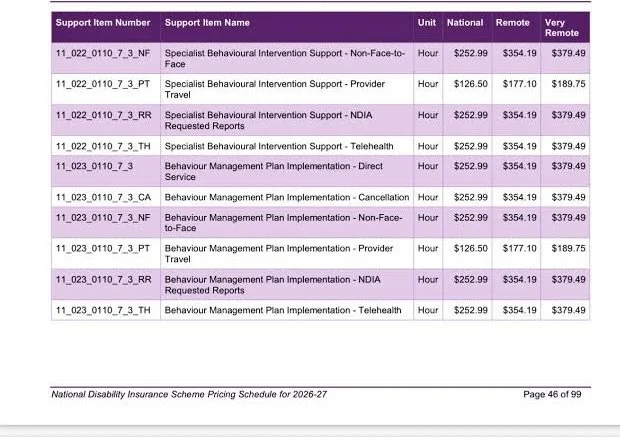
Fees - Behaviour Support - NDIS Pricing Schedule 2026
What it covers Support item numbers National. Remote. Very remote
Non-face-to-face work, such as preparation and writing documents11_022_0110_7_3_NF and 11_023_0110_7_3_NF. $252.99. $354.19. $379.49
Telehealth sessions. 11_022_0110_7_3_TH and 11_023_0110_7_3_TH. $252.99. $354.19. $379.49
Reports the NDIA asks for11_022_0110_7_3_RR and 11_023_0110_7_3_RR. $252.99. $354.19. $379.49
Short notice cancellations11_022_0110_7_3_CA and 11_023_0110_7_3_CA. $252.99. $354.19. $379.49
Travel time11_022_0110_7_3_PT and 11_023_0110_7_3_PT $126.50. $177.10. $189.75
Other travel costs, like tolls and parking 11_799_0110_7_3. $1 per unit. $1 per unit. $1 per unit
Travel time is half the hourly rate. The NDIA's pricing review for 2026-27 prices states that providers can claim up to 30 minutes of travel time to and from each participant in MMM 1 to 3 areas, and up to 60 minutes in MMM 4 to 5 areas. In remote and very remote areas, providers can make specific travel arrangements with you.
The cancellation items have the same hourly maximum as a session. Your service agreement should states how much notice you need to give, and what you'll be charged if you cancel late.
What happens if my NDIS plan doesn’t have enough money for behaviour support?
If your funding is insufficient, you can request a plan reassessment based on a change of circumstances. You’ll need to provide new evidence, such as incident reports or letters of recommendation to evidence why more support is necessary. We can help you gather the right documentation to demonstrate the impact of these services on your quality of life and independence.
Do I have to pay for the practitioner to write reports for the NDIA?
Yes, report writing is considered a “non-face-to-face” support and is billable under NDIS guidelines. These reports are vital because they provide the NDIA with the evidence needed to renew your funding and track your progress. While it’s a billable task, it ensures your practitioner can advocate for your ongoing needs with professional documentation that highlights your achievements and future requirements.
Sources
What’ s the difference between an NDIS behaviour support practitioner and a psychologist?
While both professionals focus on well-being, their primary focus differs. A behaviour support practitioner specialises in Positive Behaviour Support (PBS) to improve daily functioning and social connection. A psychologist often focuses on diagnosing and treating mental health conditions through talk therapies. Some practitioners are also psychologists, allowing them to blend of clinical insight and practical strategies to support your autonomy.
NDIS Behaviour Support Fact Sheets
Participant Fact Sheet 1 – What is positive behaviour support
Participant Fact Sheet 3 – Choosing a specialist behaviour support provider
Easy Read Fact Sheet 3 – How to choose a specialist behaviour support provider
Easy Read Fact Sheet 4 – What to expect from your specialist behaviour support provider
Easy Read Fact Sheet 5 – What to do if there is a problem with your behaviour support provider
Facilitating the development of behaviour support plans – fact sheet for implementing providers
Behaviour Support FAQs for Residential Aged Care (RAC) providers